


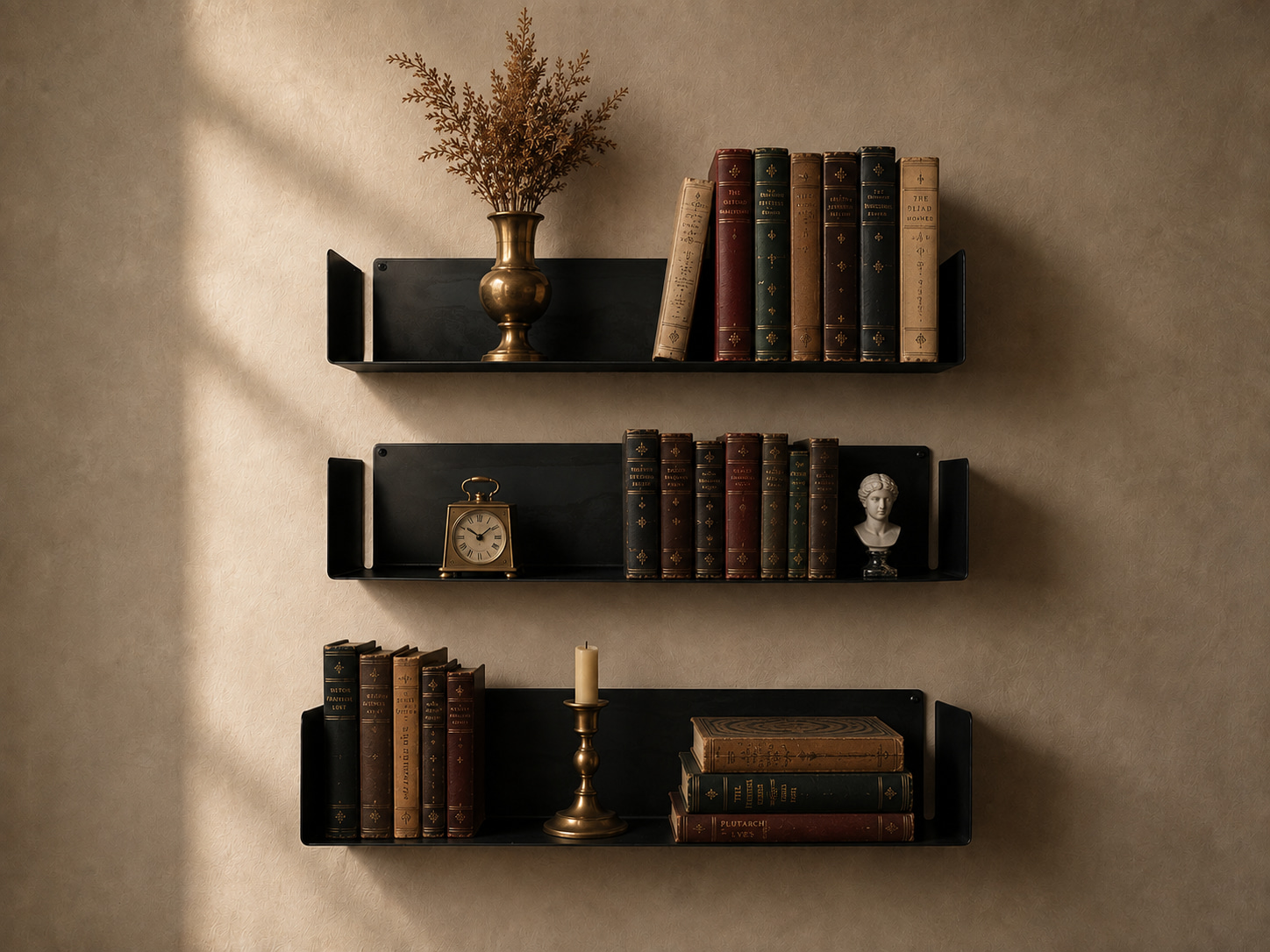
A wall of books, a brass candlestick, a warm pool of light at the foot of the shelves: dark academia begins right there, on one bookshelf. Most guides describe whole rooms with green-black walls and mahogany built-ins, but the look actually starts on a single wall, with a careful book mix and shelves that step out of the way. From there, the layers add up: a four-note palette, a handful of objects that earn their place, and warm dimmable light.
The dark academia look, in one shelf wall

Dark academia draws from old European and Ivy League universities: the Long Room at Trinity College Dublin, Duke Humfrey’s at the Bodleian, Yale’s Sterling Memorial Library, and the gentlemen’s clubs of the nineteenth century. The visual code is Gothic and Victorian: leather, mahogany, brass, candle wax, paper edges yellowed by time.
The layer of reference sets it apart from a generic cosy library. A dark academia bookshelf reads as scholarly, slightly melancholic, ornate without being flashy. The books are not props, they carry the mood. Spines visibly worn, foreign-language editions, a Latin or Greek title showing through, a Folio Society slipcase tucked between paperbacks. Pull back from the wall and you should feel that someone has been reading there for years.
The wall does most of the work. Get the shelf wall right, and the rest of the room can stay neutral, which suits anyone renting, living in a studio, or simply unwilling to repaint everything in green-black.
Start with shelves that disappear

Visible L-brackets break the illusion. The eye reads ‘flat-pack shelf’ before it reads ‘library’, and the books recede behind the metalwork. The fix is a mount that hides behind the spines, so the books appear to float against the wall.
A floating shelf in a dark finish, charcoal or matte black, also acts as the base note of the palette. Use 60 cm units for paperbacks and standard hardbacks, 45 cm for tighter compositions or vertical stacks above a desk. Set the vertical spacing between 32 and 38 cm, enough to slot in most hardbacks upright without forcing books on their side.
On a feature wall of about 1.8 m wide and 2.4 m tall, four to six shelves create a satisfying composition. Stagger the lengths (two 60 cm shelves on one level, one long 60 cm above, one shorter 45 cm to one side) so the silhouette is asymmetrical rather than gridded. Italian-made steel shelves with an invisible bracket suit this best, since the brackets disappear behind the spines and the focus stays on the books. For the foundation of the wall, our black floating shelves give the composition its colour anchor.
For installation, two screws per shelf with the right wall plug. Plasterboard takes self-drilling metal anchors rated for the shelf load, brick or concrete takes 6 mm masonry plugs. A 60 cm steel shelf holds around 15 kg, roughly forty hardbacks or sixty paperbacks.
Build a book mix that earns the look

A dark academia bookshelf needs body. Sparse shelves with three hardbacks and a candle read as showroom, not library. The Library of Congress recommends shelving books of similar size touching gently and keeping shelves at around 67% capacity, both to preserve the bindings and to let the eye rest.
The working ratio is roughly 60% upright, 30% in horizontal stacks, 10% objects. Vary the spine heights in soft waves rather than aligning everything at a strict horizon line, the irregular skyline reads as lived-in.
Spine selection matters. Penguin Clothbound Classics now run past 115 titles in 2026, and their dark forest greens, deep reds and inked blacks sit perfectly in the palette. Folio Society slipcased editions are a premium tier that gives an instantly antique presence. Below that, browse secondhand bookshops, charity shops, estate sales and online resellers like AbeBooks. A cloth-bound nineteenth-century novel picked up for the price of a coffee does more for the look than a brand-new hardback in a glossy dust jacket.
Modern paperbacks need a small intervention: pull off the bright dust jackets where the cloth underneath is dark, or turn the brightest spines towards the wall and stack them horizontally as bases for an object. Group your Penguin Black Classics together, their inked spines act as a visual anchor on a shelf. A Latin grammar, a Greek lexicon, an old atlas (anything that signals study) earns more shelf time than a popular thriller.
The four-note colour palette

A working palette for the wall sits on four notes: oxblood, forest green, charcoal and ecru. Oxblood adds depth without going full burgundy, forest green grounds the composition, charcoal is the base note that ties everything together, ecru keeps the wall breathable so the space reads moody rather than oppressive.
For the wall behind the shelves, a deep paint reinforces the depth of field. Green-black, tobacco brown or plum work better than pure black, which tends to flatten in daylight. If painting is out of the question, a strip of removable wallpaper in a small botanical pattern behind one shelf adds layer without commitment.
Metals matter as much as paint. Unlacquered brass develops a patina over months and looks more authentic than polished gold. Blackened iron candleholders, an antique-finish picture light, a small brass clock: these warm-up notes pull the palette together. Keep the metals consistent across the wall, one warm family rather than three competing finishes.
Accessories that pull their weight

The rule on a dark academia shelf: one ornate object, several quiet ones. A single marble bust is a focal point, three marble busts is a museum gift shop. Spread your statement objects across the wall, not within one shelf.
Pick from a short working set:
- A brass candlestick or candelabra with battery-operated LED candles (real flame should sit on a sideboard, not inside shelving)
- A small globe in patinated brass or stained wood
- An antique clock or pocket watch on a stand
- An apothecary jar with dried botanicals, eucalyptus, ivy or olive branches
- One or two leather-bound journals laid flat as risers
- A magnifying glass on a folded vintage map
- A framed sepia portrait or a foxed antique print leaned, not hung
Group objects in odd numbers (three, five or seven) and leave breathing room around them. A shelf packed end to end with objects loses every individual piece. Plant life softens the wood and brass: one trailing ivy in a dark ceramic pot is enough, more than two plants tips the look into cottagecore.
Light it like a Victorian study

Cold overhead light bleaches the spines and flattens the patina, where warm layered light brings the wall to life. The lighting decides whether the composition reads as scholarly or as office partition.
Work with three layers. Ambient first: a pendant or a small chandelier at 50 to 200 lux for evening movement around the room. Task next: a desk lamp or floor reader at 300 to 500 lux beside your chair. Accent last: a picture light fixed above the top shelf, or small LED pucks tucked under shelves to throw warm light onto the spines.
Hold all fixtures at 2700 to 3000K, CRI 90 or above. The warmer temperature flatters wood, leather and paper, the high CRI keeps colours true so a dark green spine actually reads as green. Every fixture should be dimmable, this is the single most important rule for the mood.
For the candle-effect signature, use flicker-flame LED bulbs in brass sconces, or in a candelabra on the floor near the shelves. Real flame stays 30 cm from anything flammable, a rule that quietly bars candles inside the shelf itself.
Putting it together

- Measure the wall and mark the shelf levels in pencil, staggered rather than gridded
- Fix the black floating shelves with two screws each, level checked twice
- Load the books first, around 60% upright and 30% in horizontal stacks across the composition
- Slip the objects into the remaining 10% in triangles of three across the wall, not within one shelf
- Light the wall in the evening, then dim until the brass starts to glow
For product-by-product styling across other aesthetics, the longer piece on styling a bookshelf extends the same composition rules.
Three reference moods
Oxford tutorial room. Forest green wall, oxblood books, brass picture lights, a worn leather chair to the side. The shelves carry mostly clothbound classics, with a small brass globe at the centre of the composition.
Hogwarts common room. Tobacco brown wall, oxblood and burgundy spines, candelabra at the foot of the wall, flicker-flame bulbs burning at low warmth. Apothecary jars and a tarnished mirror finish the composition.
Modern dark academia, rental-friendly. White or ecru wall, black floating shelves loaded with dark spines, one botanical print leaned at the end of a shelf, one warm picture light above. No paint, no built-ins, the books carry the look.
Our broader overview of bookshelf aesthetics for 2026 places dark academia next to the other moods gaining ground this year.
Starting your wall
A dark academia bookshelf does not need an Oxford college. It needs a wall, a careful book mix, a charcoal base of shelves that gets out of the way, four colour notes held to the end, and warm dimmable light. Start with one shelf wall, give it a season to settle as you read and add what survives the eye test, and the look quietly takes hold.
FAQ
Do dark academia bookshelves need built-in cabinetry?
No. The aesthetic is about books, palette and light, not joinery. Floating shelves with an invisible bracket give the same depth-of-field effect at a fraction of the cost, and without altering the wall structure of a rental.
How many books do I need for the look?
Enough to fill 65 to 70% of the linear shelf length, with a mix of upright runs and horizontal stacks. On a four-shelf composition of 60 cm shelves, 80 to 120 books reads as a settled library rather than a styled display.
Can I do dark academia in a rental?
Yes. Skip the wall paint and lean on three levers: dark floating shelves as the base note, a curated book mix with darker spines, and warm dimmable lighting. Removable wallpaper behind the shelves adds depth without damage to the wall.
What is the difference between dark academia and cottagecore on a bookshelf?
Cottagecore leans on dried flowers, pastels and soft botanicals. Dark academia leans on leather, brass and the visual cue of study: more objects of intellect, fewer flowers, a colder and deeper palette overall.
How do I make new paperbacks look at home on a dark academia shelf?
Remove the dust jackets where the cloth underneath is dark, group brighter spines together as horizontal stacks behind objects, or turn the spines inwards as a base for a leather-bound on top. Penguin Clothbound and Black Classics sit in immediately.