


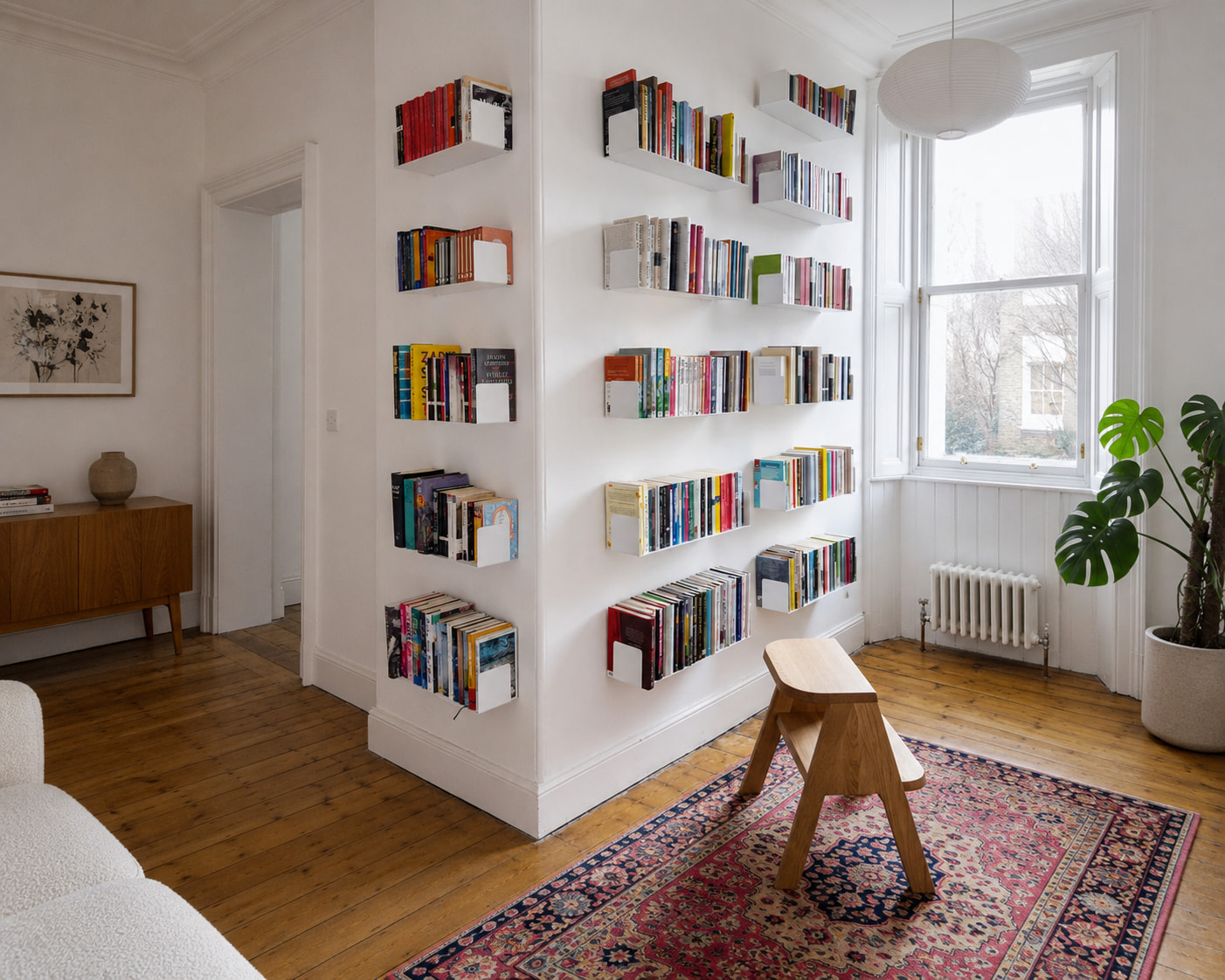
Empty wall, books in towers on the floor, a half-formed idea of what your shelves should look like in 2026: the styling part trips most people up, not the mounting. This guide pulls thirty bookshelf decor ideas under six visual identities, from modern minimalist to coastal, so you can match a mood to your wall before you place an order. Each section sets out the palette, the materials, the objects worth mixing with your books, and the kind of shelf that holds the look.
Six composition rules that hold every style together
Before the style choices, six principles run through every successful book wall in 2026. They survive trend cycles because they map onto how the eye actually reads a vertical composition, and once they’re applied the rest is mostly editing.
- The rule of three groups objects in odd numbers (three, five, seven), with mixed heights and one element clearly taller than the others.
- Asymmetry stacks books horizontally on one shelf, leans them vertically on the next, and leaves one shelf almost empty.
- Negative space keeps at least a third of the wall visible, which lets the rest of the composition breathe.
- A focal point gives each shelf one lead object (a ceramic, a small frame, a sculptural lamp), so the books support rather than compete.
- Layered depth means a leaning frame in front of a row of spines, or a small vase set on top of a horizontal stack.
- Palette restraint picks three or four spine colours and edits the rest out, or sorts everything by tone.
These six show up in every section below, even when the visible style shifts.
Modern minimalist, where the wall does most of the talking

Modern minimalist starts with subtraction: the wall colour stays neutral, the shelves disappear visually, and what remains is the spine of every book treated as a graphic element. An invisible bracket system suits this brief: no L-bracket, no upright, no MDF carcass, so the books read as floating bands of colour on plaster. A matt white or light grey finish on wall-mounted bookshelves in 15 cm depth vanishes against most painted walls, which keeps the eye on the spines.
For 2026, the palette stays cool but accepts one signal colour: a duck-egg blue jacket, a single ochre vase, a black-and-white photograph leaning against the wall. Stacks are shorter, gaps wider, and accessories restricted to one piece per shelf.
Worth trying in this register: a single 60 x 15 cm shelf at eye-height above a console, holding five hardbacks bookended by one matt ceramic; a vertical column of three 45 x 15 cm shelves spaced 30 cm apart, each carrying two books and one small object that reads top to bottom as a thin graphic line. A 60 x 25 cm shelf running along the back of a sofa, filled with paperbacks sorted into three tonal families, gives the room a horizontal anchor without dominating it.
Two further compositions round out the set: the first runs four long shelves above a desk holding nothing but books, sorted by height, with a single trailing pothos breaking the line at the right edge; the second mounts seven shelves floor-to-ceiling on a single wall, spaced 35 cm apart, with the books occupying roughly two-thirds of each shelf and the rest left deliberately empty.
Industrial, raw steel and a graphic edge

Industrial leans into texture and weight: the shelves become design objects, not invisible structures. Metal shelves in Industrial Black, with a forged-steel effect and a slightly textured matt finish, hold their own against exposed brick, board-marked concrete, dark plaster, or a deep navy wall. Antique Gold brings the same industrial character with a warmer, warehouse-inspired feel.
You’re playing on contrast: hard materials, casual content. Black steel against terracotta-bound classics, a forged matt finish paired with a single brass anglepoise lamp. Books don’t need to be perfectly arranged either; leaning stacks and asymmetric piles sit naturally within this style.
The first composition stacks two Industrial Black shelves 40 cm apart above a workbench-style desk, with books leaning at angles and one heavy hardback laid flat on top, weighted down by a brass desk lamp. A second setup runs four 60 × 15 cm Antique Gold shelves across a chimney breast, holding art monographs and one black sculptural object per shelf. For a stronger graphic statement, a 60 × 25 cm Industrial Black shelf creates a single horizontal line above a leather sofa, mixing horizontally stacked hardbacks with vertically arranged paperbacks and anchored by an industrial-style desk lamp at one end.
Two further compositions complete the look: a column of three 60 × 15 cm Industrial Black shelves on an exposed brick wall displays books alongside a stack of vintage cameras or a single forged-iron object, while a 60 × 15 cm Industrial Black shelf mounted above a compact sideboard or record cabinet supports a record player, a stack of leaning hardbacks, and a few carefully chosen industrial accessories. The clean steel profile stands out deliberately against a pale wall, adding contrast without overwhelming the space.
Vintage mid-century, warm wood and soft curves

Mid-century revival is back in force for 2026, with atmospheric palettes, retro-soaked seating, and book walls that look lived-in by a 1962 architect. The bookshelf side here usually mixes wall-mounted steel with low-slung mid-century furniture: a teak sideboard underneath, a leather lounger angled to the side, a globe lamp casting warm light at floor level.
The Copper Terracotta and rust-colour shelves echo the warm-metal palette of the era. Antique Gold reads beautifully on plaster walls painted in deep teal or mustard. Books with cloth-bound spines or vintage Penguin paperbacks suit the era’s printing aesthetic, and the accessories trend toward atomic-era ceramics with rounded silhouettes.
The first composition runs three 60 x 15 cm Copper Terracotta shelves above a teak sideboard, each shelf carrying a mix of art monographs and one ceramic in an atomic-era shape. Stack a pair of 60 cm vertical bookcases into a single column for a second option, with paperbacks colour-sorted into olive, ochre, and cream. A third setup places a 60 x 25 cm Rust shelf above a low velvet armchair, holding photography books laid flat with one curved ceramic on top.
Two more compositions close the register: a pair of 45 x 15 cm Antique Gold shelves flanks a sunburst mirror or a circular framed print, holding three small objects each; a column of six 45 x 15 cm shelves on a teal-painted wall holds hardbacks horizontal with one mid-century pottery piece per shelf, sparse enough that the wall colour stays the lead actor.
Scandi-japandi, serene neutrals and quiet craft

Scandi-japandi is what most readers now mean when they say ‘minimalist with warmth’. The palette pulls from natural wood, oat, putty, soft black, and the occasional charcoal. Composition principles run stricter than modern minimalist: fewer objects, more pause, every piece chosen for its silhouette and material rather than its colour.
A White, Natural Grey, or Industrial Black wall shelf in a thin 15 cm depth reads as a single horizontal line against pale plaster, and a set of three floating shelves hung at staggered heights builds a quiet vertical rhythm. Books are kept light in colour, with neutrals, kraft, ivory, and the occasional matt black hardback. Greenery is small and structural, a single succulent in a stoneware pot rather than trailing chaos.
The first composition mounts a 60 x 15 cm White shelf at half-wall height holding three hardbacks, one stoneware vase, and nothing else. A second option runs a vertical column of four 45 x 15 cm White shelves, each carrying two paperbacks, a small ceramic, and one Japanese-inspired object (a wooden tray, a folded linen napkin, a paper lantern). For a horizontal setup, pair two 60 x 15 cm Natural Grey shelves spaced 35 cm apart above a low oak bench, each supporting a flat-laid art book topped with a single ceramic.
Two more compositions complete the register: a horizontal row of three 45 x 15 cm shelves in soft black on an oat-coloured wall holds books sorted by spine tone, light to dark, left to right; a 60 x 25 cm shelf above a futon-style sofa carries photography books, a small bonsai, and one hand-thrown bowl. The register fails when one object too many slips in, so editing back is usually the right reflex.
Boho, layered colour and collected objects

Boho rejects restraint and rewards layering, so the wall becomes a backdrop for everything you’ve collected: woven textiles, ceramics in three different glazes, books with colourful jackets, plants that cascade past the shelf edge. The shelf itself can stay quiet (white or natural grey) when the content does the heavy lifting, or it can join in via coloured wall shelves in rust, terracotta or antique gold.
The 2026 boho register tones down the saturation of the 2010s: fewer dreamcatchers, more earth pigment. Terracotta, deep moss, ochre, dusty rose, and clay tones replace the older neon palette. Books often carry visible patina, with secondhand finds in cloth covers and gold-leaf titling stacked alongside contemporary paperbacks.
The first composition mounts a 60 x 25 cm shelf above a rattan sofa, holding paperbacks laid flat, a chunky ceramic vase filled with dried pampas, a small stack of vintage travel books, and a string of brass beads draping over the edge. The second builds a column of five 45 x 15 cm shelves, with each shelf carrying two books, one trailing pothos, and one collected object (a stone, a small framed photograph, a textile fragment).
Three further setups round out the range: a long 60 x 15 cm shelf above a doorway packs in cookbooks and a row of three terracotta pots; two 60 x 15 cm shelves in Rust mounted at staggered heights above a kilim rug hold a mix of art books, a hand-thrown bowl filled with dried citrus, and one woven basket; a 60 cm vertical bookcase becomes a freestanding plant-and-book corner, with three trailing plants and books in heavy stacks at the base. Boho stays alive when you rotate one or two objects every season.
Coastal, pale wood and sea light

Coastal in 2026 has moved on from rope and rudders. The new register sits closer to a quiet seaside cottage than a tiki bar: bleached oak floors, pale plaster, weathered linen, hand-thrown stoneware, and books that look read on a beach. The palette pulls from chalk, oat, soft sage, sand, and one mid-blue, with white and natural grey shelves doing most of the visual work.
White and Natural Grey shelves in 60 x 15 cm or 45 x 15 cm formats sit cleanly against pale walls. Books often lean towards photography, sailing, natural history, and old-edition novels with sun-bleached spines. Accessories trend toward objects with a slight patina: driftwood, ceramic in matt glaze, woven seagrass.
The first composition runs a long 60 x 15 cm White shelf above a sun-faded linen sofa, holding flat-stacked photography books with a single piece of driftwood and a stoneware jug. A second setup builds a vertical column of four 45 x 15 cm White shelves on a chalky white wall, each carrying one art book, a small shell or pebble grouping, and a sprig of dried sea lavender.
Three more setups close the coastal register: a pair of 60 x 25 cm shelves in Natural Grey above a sideboard painted soft sage holds hardbacks bookended by ceramic jars stuffed with rolled-up nautical maps; for a single horizontal line, a 60 x 15 cm shelf above a reading chair near a south-facing window holds three paperbacks, a hand-thrown bowl, and one small succulent, with the sea light doing most of the rest; a horizontal run of three 45 x 15 cm shelves sits under a print of a coastal landscape, with books sorted by spine tone (oat, sand, mid-blue, white). Resist the urge to add nautical motifs: the palette and the patina carry the brief.
From mood to mounting, a short checklist before you drill
You’ve picked a style, so the remaining work is making sure the wall and the order match the look. Five checks before anything goes up:
- Measure the wall length and the height between obstacles (skirting, ceiling rail, light fittings). Most shelves come in 30, 45, and 60 cm widths, and sketching the run on graph paper takes ten minutes and saves a returned set.
- Choose the set size after measuring books: five paperbacks weigh roughly 1 kg, five hardbacks closer to 2.5 kg. A 60 x 15 cm shelf holds up to 15 kg of evenly distributed weight, plenty for a packed shelf, but worth confirming when you’re stacking art monographs.
- Identify the wall type. Plasterboard needs heavy-duty plasterboard fixings rated for the load; brick or concrete takes wall plugs and 50 mm screws. The shelves themselves install with two screws.
- Lay the composition out on the floor first. Place the books, the ceramics, and the framed art on the floor in the exact arrangement you want on the wall, photograph it, adjust, then mount.
- Live with it for a week before adding anything more. The eye needs time to read a new composition, and the urge to over-fill tends to win on day one. Wait, then edit.
If you’re still hesitating between formats, the bookcases collection covers the vertical and free-standing options that pair well with any of the six styles above. Seventeen years of making wall-mounted shelves in Italian steel taught us one thing in particular: the hard part is never the mounting, it’s deciding what stays on the wall once you’ve stepped back.
Frequently asked questions
What goes on a bookshelf besides books?
Ceramics, small framed prints, sculptural objects, one trailing or potted plant per shelf, a folded textile, a stoneware bowl, a candle, a stack of magazines laid flat, or a single piece of driftwood. Pick objects that mix in three height bands (tall, medium, short) and stay close to the wall colour palette.
What is the rule of three on a bookshelf?
The rule of three groups objects on a shelf in odd numbers, usually three, with mixed heights and a clear lead object that’s taller than the others. The eye reads odd-numbered groupings as composed rather than staged, which is why three works better than two or four.
How do you decorate a minimalist bookshelf?
Restrict the palette to two or three spine tones, keep accessories to one piece per shelf, leave at least a third of each shelf empty, and resist filling gaps over time. A matt white or light grey shelf in 15 cm depth keeps the line thin enough that the books read as the composition, not the shelf.