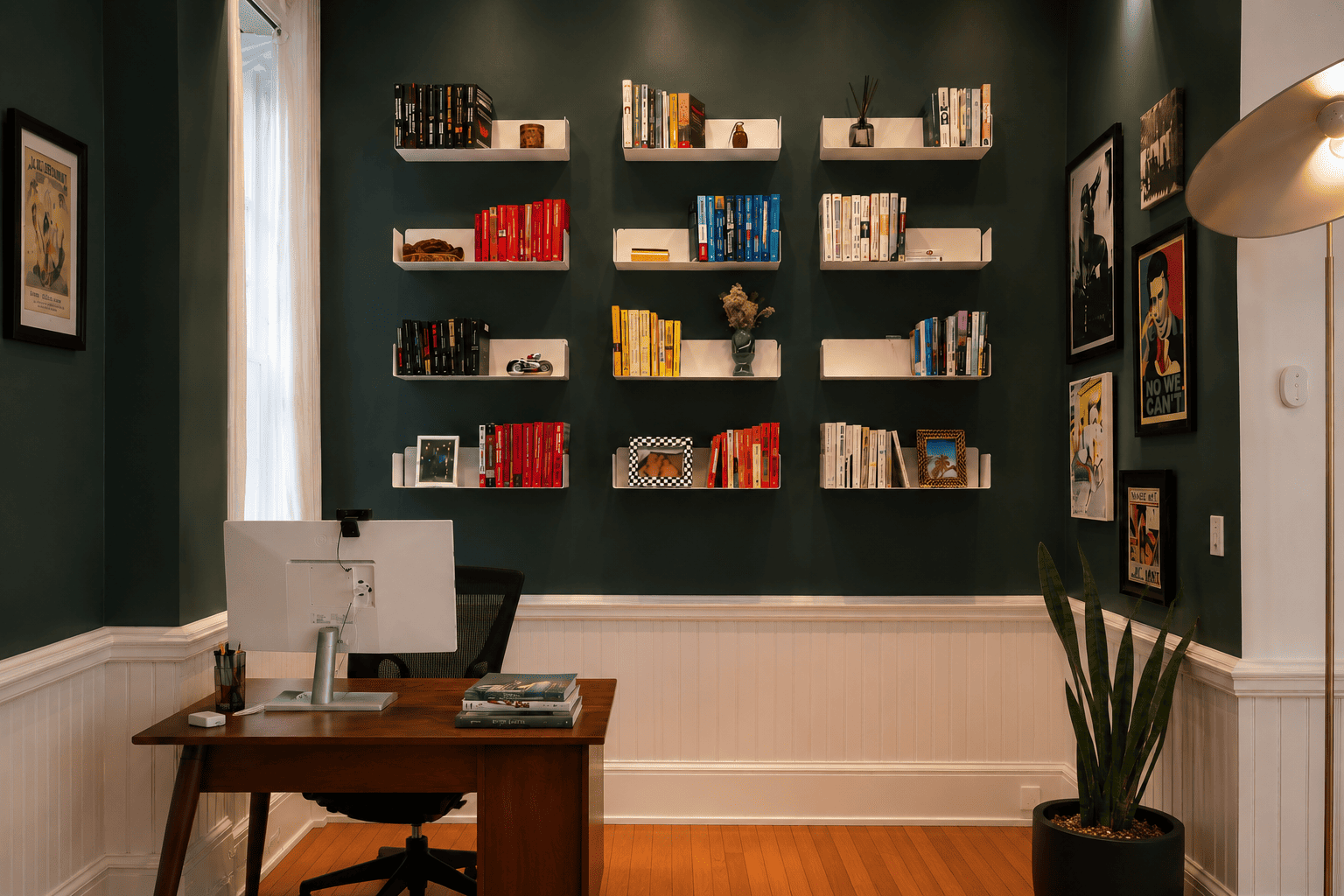
A floating bookshelf does one thing standard shelving cannot: it turns the books into the wall composition itself. With the bracket hidden behind the spines, the eye reads only stacks of colour and paper, suspended in mid-air against the paint. The visual result depends almost entirely on how you arrange the shelves, not on the shelves themselves. The 15 compositions below work in different rooms and on different wall sizes, grouped by the visual effect you’re after. If you want the practical side first, the dedicated guide on how to hang floating bookshelves covers the install.
Full-wall compositions for a library effect
A floating bookshelf is at its most striking when it scales. Cover the wall and the room reads as a library; cover half and it reads as decoration. The three layouts below give you a proper library feel without the bulk of a freestanding bookcase.
A floor-to-ceiling grid behind the sofa

Stack six to eight rows of 60 cm shelves up the wall behind the seating area, evenly spaced 30 to 35 cm apart so a standard hardback fits without overhang. The grid pattern repeats from skirting to ceiling and reads as one continuous surface of spines rather than a stack of individual shelves. Anchor the bottom row at 50 cm from the floor so the lowest books stay out of the kicking zone and the dust line. For walls wider than 3 metres, pair two columns of shelves side by side, leaving a 10 cm gap between them to keep the alignment crisp.
Continuous horizontal lines across the whole wall

Run three or four 60 cm shelves end to end across the wall in straight horizontal lines, with no break between them. Each line becomes a continuous band that draws the eye sideways across the room. Keep all shelves at the same depth (15 cm works for paperbacks, 25 cm for hardbacks and folio editions) so the silhouette stays consistent and no row breaks the rhythm. Long walls in narrow living rooms and corridors hold this layout best, especially when the books should feel like architectural trim rather than a feature piece.
A high library above eye level

Start the first shelf at 180 cm from the floor and stack three to four rows above it, all the way to the ceiling. The lower wall stays clear for a console, a sofa or artwork; the upper third becomes a band of books that frames the room. Use the same set of floating shelves across the whole band to keep the geometry tight, and pick books with similar spine heights for the upper rows where they read most clearly from below. Ceilings above 2.6 metres carry this composition best, since the shelf line needs the headroom to read as a band rather than a single high row.
Asymmetric arrangements that still feel deliberate
Symmetry is easy; asymmetry is harder to pull off without looking accidental. The three layouts below use an anchor (one longer shelf, one column, one repeated element) to give the eye somewhere to settle, even when the rest of the composition reads as scattered.
A stepped arrangement that draws the eye upward

Arrange four or five floating small bookshelves so they rise diagonally across the wall, with each shelf sitting slightly higher than the previous one. Unlike a strict grid, the composition introduces movement while still feeling organized because every shelf follows the same upward rhythm. Leave generous empty space around each shelf so the books become individual focal points rather than one continuous block. This approach works especially well in bedrooms and compact rooms where a full library wall would feel too heavy, creating a light composition that naturally leads the eye toward the ceiling.
An off-centre cluster around an anchor shelf

Pick one long shelf (60 or 80 cm) as the visual anchor and place it slightly off-centre on the wall, around two-thirds of the way to one side. Add a few shelves (12 to 20 cm) above and below it, each one slightly offset horizontally, so the composition feels grouped rather than spread out. The anchor holds the eye; the satellites add rhythm without competing for attention. Hang the cluster on a wall that already carries furniture on one side (a desk, an armchair, a low cabinet); the visual weight of the cluster then balances the existing piece rather than competing with it.
Scattered single shelves at varying heights

Hang four to six single shelves at deliberately uneven heights and spacing, treating the wall like a gallery hang rather than a bookcase. Vary the lengths (mix 30, 45 and 60 cm) and keep the depth identical so the wall still feels coherent across the differences. Put two or three books per shelf, not more, so each shelf reads as its own object rather than a row of storage. Save this for stairwells and narrow hallway walls, where the eye passes quickly and each shelf has to register on its own rather than as part of a row.
Shelves above a sofa or a bed
The space above a sofa or a bed is the largest piece of decorating real estate in most rooms, and it almost always sits empty. Floating shelves fill it without the visual weight of framed prints or a wall-to-wall bookcase. Two rules apply across both versions: leave clearance for people sitting or lying below, and keep the line proportional to the furniture.
Three stacked shelves above a low sofa

Centre three 60 cm shelves above the sofa, starting 25 to 30 cm above the backrest (the standard designer clearance), with 30 cm gaps between each row. The shelf line should be roughly the same width as the sofa, so the eye reads them as a single block centred above. Use the rows for art books, a small stack of paperbacks and one or two objects per shelf, not a full library run. Above a three-seater (around 200 cm), a 180 cm shelf line sits proportionally; above a two-seater, drop to two shelves of 45 cm so the band stays balanced.
A single long shelf above the headboard

A single horizontal shelf 25 to 30 cm above the headboard reads as a finishing line that frames the bed without the risk of falling objects at face height. Match the shelf length to the bed width (140 cm for a double, 180 cm for a king) so the proportions sit right and the line does not run off into the wall. Keep the styling sparse: a few hardbacks, one ceramic, a small bedside lamp if the shelf is deep enough. If the shelf is purely decorative and the bed is rarely used for reading, push it up to 60 to 75 cm above the headboard for a more graphic, gallery-like effect.
Mixing books, plants and objects
A floating shelf filled edge to edge with paperbacks reads as storage; a floating shelf with three books, a plant and a ceramic piece reads as composition. The difference between the two is mostly a question of ratio, not of taste. The three ideas below give you working formulas rather than vague styling advice.
The 60/30/10 rule for books, objects and breathing room

The rule is straightforward and survives most styles:
- 60% of the shelf length is books, stacked vertically with a few horizontal piles for variation
- 30% is non-book objects: ceramics, framed pieces, a single sculpture, a candle
- 10% is deliberately empty space, so the eye has somewhere to rest
Vary heights within the 60% so the spines climb and dip rather than forming a flat top. Cluster objects in groups of three, since odd numbers read as more natural than pairs. Repeat the formula loosely from shelf to shelf, not identically, or the composition starts to feel templated.
Trailing plants between book stacks

Add one trailing plant (pothos, string-of-pearls, ivy) per three shelves and let the leaves spill down between the rows. The greenery breaks the strict horizontal lines and adds depth that books alone cannot. White floating shelves work especially well here because the green reads stronger against a neutral background, where coloured or black shelves can compete with the foliage. Keep the plant pot small (10 to 12 cm) so it does not dominate the shelf width; the trailing leaves do the visual work, not the container.
A reading-corner shelf with a lamp and one ceramic piece

Above an armchair or by a window seat, hang a single 60 cm shelf at 130 to 140 cm from the floor (within arm’s reach when seated). Place a stack of five or six current reads on one side, a small table lamp on the other, and one ceramic or wooden object in between. The shelf becomes a functional extension of the chair rather than pure decoration, and the surrounding wall stays free of clutter. Pick a depth of 25 cm so a lamp base sits stable, and route the cable down behind the chair so it stays out of sight.
Levitating books, the invisible bookshelf version
The defining trick of the category is the mount that disappears once books are loaded. With the right invisible bookshelves, the metal hides between the back cover and the back page of a hardback, leaving only the stack visible on the wall. The two layouts below push the effect as far as it goes.
Stacked horizontal piles that hide the bracket

Line up three or four invisible shelves down the wall in a vertical column, spaced 35 to 45 cm apart, and load each one with a stack of five to seven hardbacks lying flat. The first hardback sits on the mount, the rest pile on top, and the metal vanishes inside the bottom book. From a metre away, the wall reads as four floating piles of books with no visible support at all. Save this for a clear wall with no competing artwork, since the illusion of unsupported piles is what carries the whole composition.
A vertical tower climbing up a tall wall

On a narrow strip of wall (between a doorway and a corner, for instance), stack six to eight invisible shelves vertically, 30 cm apart, with three or four books per shelf. The result is a column of books that runs from waist height to the ceiling, taking up the width of one book and nothing else. The layout turns dead vertical space, often the awkward bit beside a chimney breast or a radiator, into a graphic element on the wall. Pick books with consistent spine height for the cleanest column line.
Room-by-room ideas beyond the living room
Floating shelves are mostly associated with living rooms, but the categories of walls they suit best (long, narrow, awkward, underused) appear all over the house. The two examples below cover the rooms that gain the most from a floating layout.
A hallway line that turns wasted wall into a library

A hallway is almost always too narrow for a freestanding bookcase but plenty wide for a shelf 15 cm deep. Install one or two rows of floating bookshelves along a section of the hallway wall, positioned around 140–150 cm from the floor, to create a compact library display without obstructing the walkway. The shelves hold the books while keeping the lower wall clear, transforming an otherwise unused hallway into a functional display area. Limit yourself to one or two rows so people can walk past comfortably, and keep the books spine-out rather than stacked so the composition stays clean.
Floating shelves above the desk in a home office

Anchor two floating shelves above the desk, with the first positioned 35 to 40 cm above the desktop to leave enough clearance for a computer screen and the second around 35 cm higher. The lower shelf keeps frequently used books within easy reach, while the upper shelf is ideal for reference books and completed projects. Keep the shelves slightly shorter than the desk by 10 to 15 cm on each side so the composition feels balanced and intentional. If you need additional storage for tall hardbacks or folio formats that exceed a 25 cm shelf depth, a vertical bookcase can sit neatly at one end of the workspace.
Choosing the right shelf set for your composition
The composition decides the set you need, not the other way around. Three quick rules cover most cases:
- A full-wall library or a stacked column reads better with sets of 6 (60 x 15 cm), so the geometry stays consistent and you avoid mixing batches
- Asymmetric and scattered layouts call for individual shelves in mixed lengths (30, 45 and 60 cm) so you can vary the rhythm
- Invisible compositions take the small 12 x 12 cm bracket for five-book stacks, or a longer shelf depth for heavier piles
The Italian-made steel keeps the fixing thin enough to disappear behind a single hardback, and the two-screw mount fits standard plasterboard with the right plug. Stick to one colour family across the composition (all white, all black, all rust) so the wall reads as one piece rather than a patchwork of finishes.
Frequently asked questions
How much weight can a floating bookshelf hold?
A steel floating shelf properly fixed into a stud or solid masonry typically holds 20 to 25 kg per fixing point. On plasterboard with the right toggle bolts, the figure drops to around 15 kg per shelf. For reference, five hardbacks weigh roughly 2 to 3 kg, so a 60 cm shelf comfortably holds a normal stack with margin to spare.
How high should a floating shelf be above a sofa?
The designer standard is 25 to 30 cm above the backrest. The clearance leaves enough room for someone sitting tall without hitting the shelf, and keeps the composition visually connected to the sofa rather than floating off into the wall on its own.
Are floating bookshelves out of style?
No, and the trend has moved in the opposite direction. As built-in joinery has become more expensive and renters look for less invasive solutions, slim wall-mounted shelves have replaced fitted bookcases in plenty of contemporary flats and renovated period homes. The look has also broadened: matte black, antique gold and rust finishes now sit alongside the classic white version.
How do you make a floating bookshelf look invisible?
Use a shelf with a thin L-shaped bracket that slips inside a hardback (between the back cover and the back page) and pile five to seven books on top. The metal disappears behind the bottom book and the rest of the stack sits on top, hiding the support entirely. The trick works only with hardbacks, since paperbacks are too thin to conceal the fixing.
The wall in front of you only looks finished when the shelves carry both books and a small amount of empty space. Start with one composition (an asymmetric cluster, a single shelf above a sofa) before scaling up to a full wall, and the proportions become easier to judge than they ever are from photographs. When you’re ready, the full range of Teebooks floating shelves covers every length and finish needed to build any of the 15 compositions above.
