


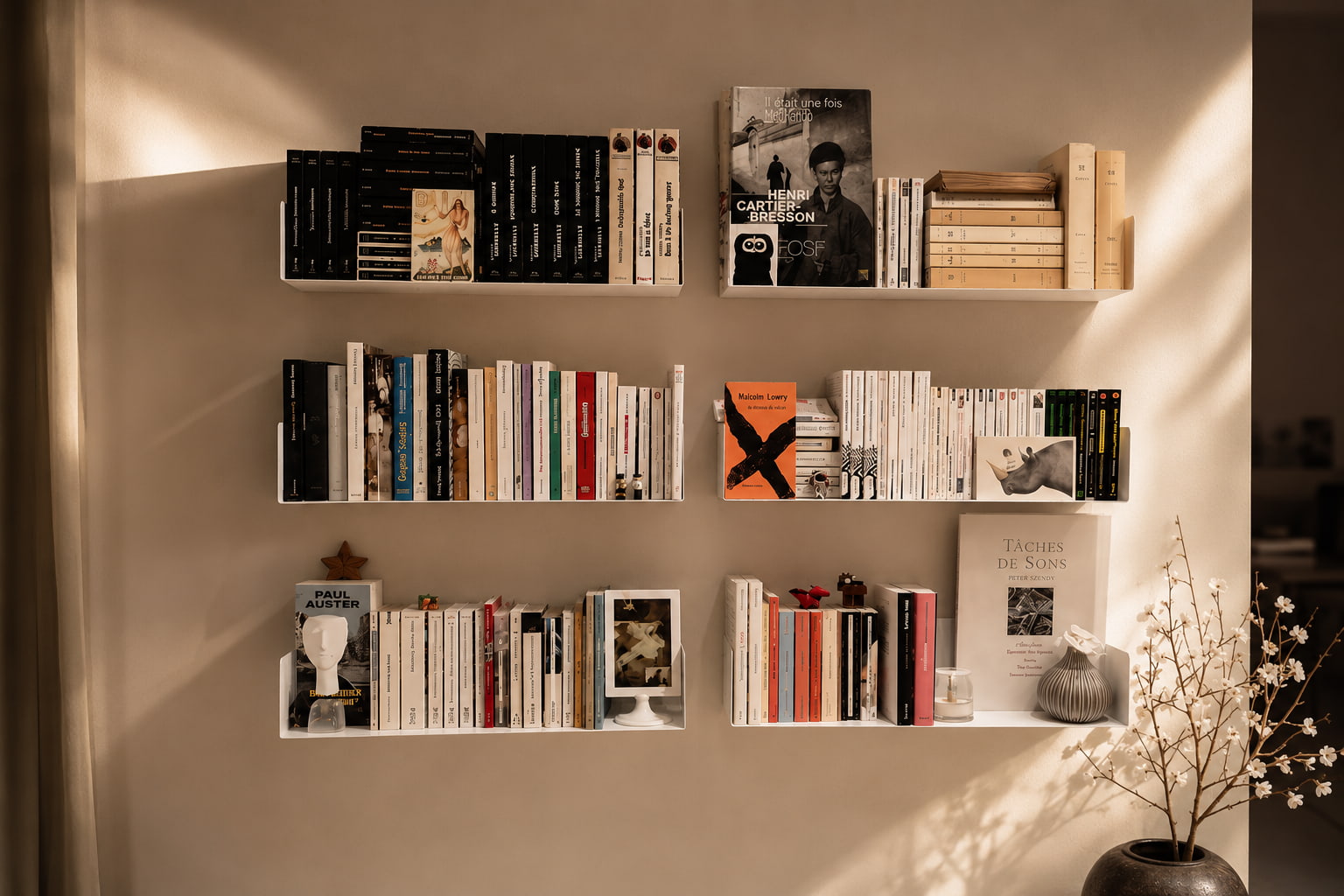
How much weight can a bookshelf hold? It depends on the shelf. A compact wall-mounted bookshelf may have a maximum recommended load of 7 kg, while a deeper, heavy-duty metal shelf can support up to 40 kg on a solid wall with suitable fixings.
But weight isn’t the whole story. To choose the right bookshelf, you need to consider maximum recommended load, shelf dimensions and book size together. Here’s how to compare them before buying.
What is the maximum weight capacity of a floating bookshelf?
There is no universal maximum for a floating bookshelf. Capacity depends on the shelf’s construction, dimensions, mounting system and wall type. Teebooks models have maximum recommended loads ranging from 7 kg to 40 kg.
How many books can a bookshelf hold? 8 Teebooks models compared
| Bookshelf | Dimensions | Maximum recommended load | Approximate book capacity |
|---|---|---|---|
| SL | 12 × 12 cm | 7 kg | 15 small paperbacks or around 8 larger novels |
| U30 | 30 × 15 cm | 10 kg | 20 small paperbacks or around 15 larger novels |
| U45 | 45 × 15 cm | 12 kg | 30 small paperbacks or around 20 larger novels |
| U60 | 60 × 15 cm | 15 kg | 40 small paperbacks or around 25 larger novels |
| UV60 vertical | 60 cm high × 15 × 15 cm | 20 kg | Around 45–50 small paperbacks or 30 larger novels |
| UV45 vertical | 45 cm high × 20 × 20 cm | 30 kg | Around 15–20 large-format books |
| UBD45 deep shelf | 45 × 25 cm | 30 kg | Around 15–20 large-format books |
| UBD60 deep shelf | 60 × 25 cm | 40 kg | Around 20 large-format books |
These are the maximum loads Teebooks recommends for each model on a solid wall with suitable fixings. Do not exceed them. Book counts are approximate and depend on the books’ size and weight. Plasterboard requires appropriate fixings and a lighter load than the solid-wall recommendation.
For everyday novels, a U60 may be sufficient. For large art books and illustrated cookbooks, the deeper UBD45 and UBD60 offer more space and higher maximum recommended loads.
How much do books weigh?

Book weight varies considerably. A shelf filled with small paperbacks carries a different load from one holding thick hardbacks or oversized illustrated books.
- Small paperback: Around 200–350 g.
- Larger paperback novel: Around 350–600 g.
- Hardback novel: Around 500 g to 1 kg.
- Large art book or illustrated cookbook: Around 1.5–3 kg, sometimes more.
These are rough estimates. Paper type, page count and dimensions all affect the result, so weighing your own books gives you a more reliable figure.
How many books is 15 kg?
15 kg is roughly 50–60 lightweight paperbacks, 30 books weighing 500 g each or 15 books weighing 1 kg each. But weight alone doesn’t tell you how many books will fit on a bookshelf.
For example, the Teebooks U60 measures 60 cm long, accommodates around 40 small paperbacks or 25 larger novels, and has a maximum recommended load of 15 kg on a solid wall with suitable fixings.
A simple way to check your books before buying
You can check both the space and the weight using the books you actually intend to display:
- Measure the shelf length. For a U60, you have 60 cm of shelf length.
- Arrange your books in a row. Stand them upright, side by side, as they would sit on the shelf. Keep the row just under 60 cm long and check that the books fit the shelf’s depth.
- Weigh the complete row. Put those books on a scale together, or weigh them in batches and add the results.
- Compare the total. If the books fit within the dimensions and their combined weight does not exceed 15 kg, they meet the U60’s book-size and maximum-load requirements for a suitable solid-wall installation.
One row, two answers: You know whether your books will fit and whether they stay within the shelf’s maximum recommended load. The same method works for other horizontal bookshelves; for vertical and stacked displays, check the relevant dimensions and arrangement.
What determines a bookshelf’s weight capacity?
Five factors influence how much weight a bookshelf can hold:
- Material: Wood, MDF, particleboard and steel behave differently under load.
- Length and thickness: Longer, thinner shelves can be more prone to bending.
- Mounting system: The shelf’s supports and fixings transfer its load to the wall.
- Wall type: Solid masonry, timber studs and plasterboard have different fixing requirements.
- Weight distribution: Concentrating heavy books in one area places different stresses on the shelf.
Bookshelf weight capacity: wood, MDF or steel?

MDF and particleboard
Common in flat-pack furniture, MDF and particleboard can gradually bow under sustained heavy loads, particularly across long unsupported spans.
Solid wood
Solid wood can be sturdy, but its resistance depends on the species, thickness and distance between supports. Long shelves may need additional brackets.
Folded Italian steel: strength and resilience

Teebooks uses folded Italian steel to combine a minimalist design with excellent structural resistance. The steel’s natural elasticity allows it to respond to everyday loads while retaining its shape, while the folded construction adds rigidity without unnecessary bulk.
This combination of strength, resilience and thoughtful design makes steel particularly well suited to wall-mounted bookshelves. Unlike some wood-based materials that can develop a lasting bow over time, a properly designed steel shelf can resist permanent deformation when used within its specified load capacity.
Which floating shelves have a high weight capacity?

For wall shelves that can hold a lot of weight, three Teebooks models offer maximum recommended loads of 30 to 40 kg on solid walls with suitable fixings:
- UV45 – 30 kg maximum: Vertical bookshelf measuring 45 cm high, 20 cm wide and 20 cm deep, holding around 15–20 large-format books.
- UBD45 – 30 kg maximum: Deep horizontal shelf measuring 45 × 25 cm, holding around 15–20 large-format books.
- UBD60 – 40 kg maximum: Deep horizontal shelf measuring 60 × 25 cm, holding around 20 large-format books.
Choose the UV45 for a vertical display, the UBD45 for a shorter horizontal shelf or the UBD60 for more length and the highest maximum recommended load of the three. Book counts are approximate, so always check the actual combined weight.
Explore the complete Teebooks range of metal shelves to compare sizes and formats.
Once installed, a few habits help you use your shelves sensibly:
How to distribute weight across wall shelves

- Spread the weight: Avoid concentrating heavy books in one small area.
- Use several shelves: Divide larger collections rather than overloading one shelf.
- Include decorative objects: They count towards the total load too.
- Respect the maximum recommended load: Check the manufacturer’s rating and the suitability of your wall and fixings.
The right bookshelf fits your books in both dimensions and weight. Measure your collection, weigh it and choose a shelf that meets both requirements.