


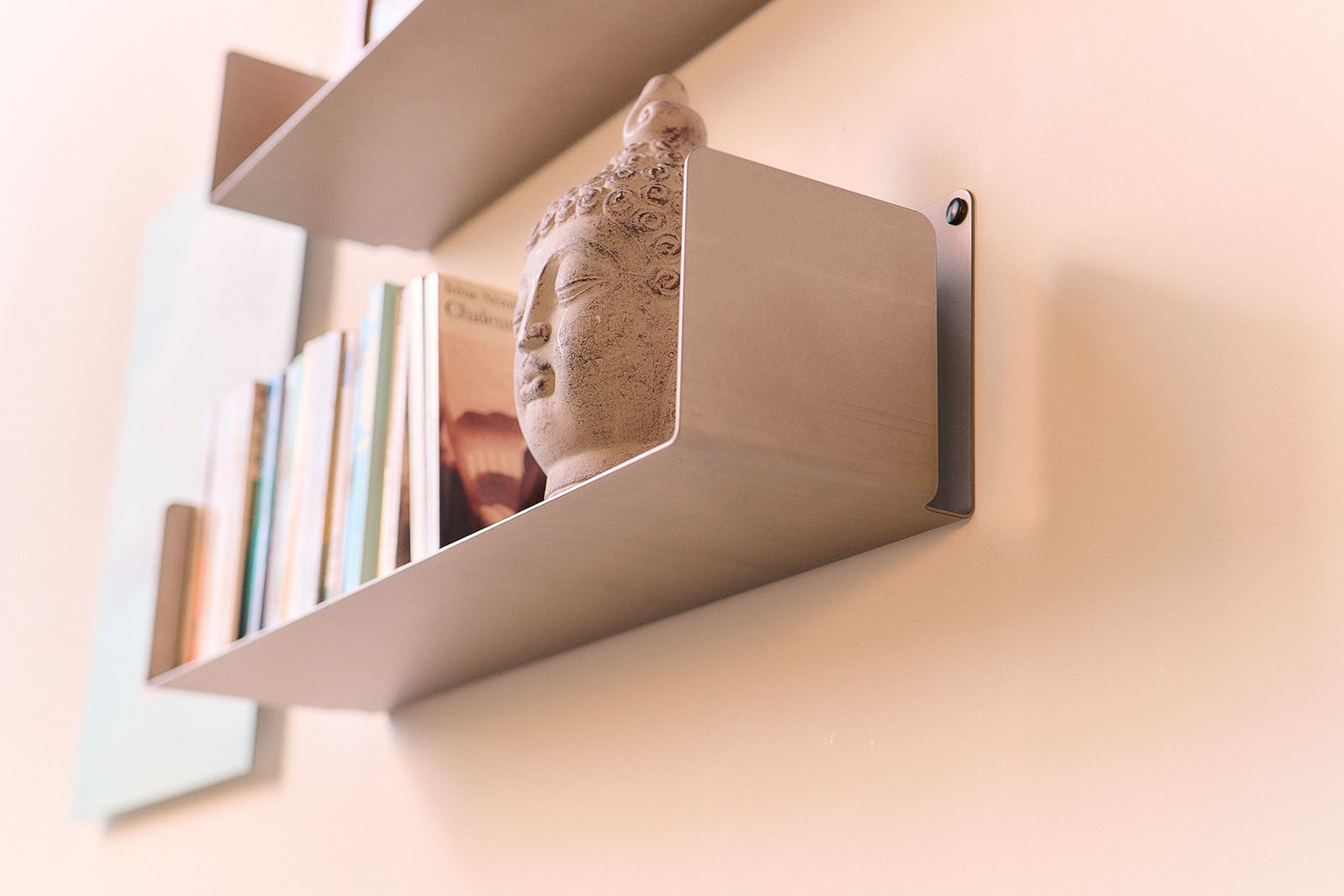
The figure most guides quote is 25 to 30 cm, but it’s overkill for the way people actually shelve books today. A B-format paperback measures 13 cm wide, while most standard hardbacks are only slightly deeper. Once you’ve taken stock of what’s on your shelves, the case for a deeper unit gets thinner than expected.
Most home libraries only need 15 cm

The 25 to 30 cm figure comes from the era of floor-standing built-in bookcases designed to hold encyclopaedias, ledgers and a mix of everything else. A typical home library today leans on paperbacks and trade-format fiction with a handful of hardbacks. Most standard hardbacks fit comfortably on a 15 cm shelf, while larger hardbacks are better suited to a deeper one.
A shallow shelf earns its place for another reason: it keeps the wall visible behind the books, which makes a small room feel less cluttered. The deeper the shelf, the more it reads as furniture; the shallower it is, the more it reads as architecture. That distinction is what sets the rules for the three depths that follow.
Standard bookshelf depths and what they’re actually for
Three depth options cover almost every realistic scenario. Each one matches a specific kind of collection, and most over-buying comes from picking the wrong depth for the books actually involved.
Shallow shelves (15 cm)

A 15 cm shelf holds A-format, B-format, trade paperbacks and most hardbacks. It works in narrow rooms, hallways, alcoves and above desks, where a 25 cm unit would close the space down. The spines do the visual work and the bracket disappears behind them, which is why 15 cm deep floating shelves have become the signature depth across the Teebooks range.
Standard depth (25 cm)

This is the figure older guides quote when they say ‘standard’. A 25 cm shelf swallows almost any mainstream hardback, including large-format biographies and illustrated non-fiction. It’s also the realistic floor for vinyl records, which need 32 cm of width and around 25 cm of breathing room to sit upright.
Deep shelves (35 cm)

At 35 cm, you’ve left the realm of regular reading and entered display territory. A 35 cm shelf takes a Taschen XXL spread without the corners hanging over the edge, and accommodates atlases and photography monographs that overflow narrower units. Below 35 cm, the largest art books tip forward or sit at an angle, which damages the binding over time.
Shelf depth by book type
The other way to pick a depth is to start from the books themselves: standard publishing formats fall into four families, and each family’s width sets the minimum shelf depth required.
Paperbacks
Mass-market paperbacks measure around 11 × 17.8 cm. B-format, the common standard for fiction, sits at 13 × 19.8 cm. Trade paperbacks land at 15 × 23 cm. All three sit on a 15 cm shelf with the spine either flush against the bracket or set back, depending on the model. For a collection that runs at roughly 80% paperback, which describes most readers’ bookshelves, 15 cm is not a compromise but the dimension the books were quietly asking for all along.
Hardbacks
Most hardbacks fall into two width bands. Demy-style hardbacks (13.8 × 21.6 cm) fit on a 15 cm shelf without issue. Larger hardbacks are the trickier ones: for collections dominated by the smaller hardback formats, 15 cm holds up well. For a wall of larger contemporary hardbacks, 25 cm gives a comfortable margin.
Art books and coffee table formats
Art books and photography books vary widely, but most sit between 25 and 30 cm wide. A standalone shelf at 35 cm depth is the right home for them. Many readers keep these on the lower shelves of a deeper unit, while running shallower 15 cm shelves above for the rest of the library. That mixed-depth approach makes more sense than picking a single deep dimension for the whole wall.
Vinyl records, atlases and oversized items
Vinyl LPs are 31.4 × 31.4 cm. They require both 33 cm of width per shelf section and a depth of 25 cm minimum to sit upright without tipping. Atlases and large reference works follow the same logic. If you’re building a unit that has to handle these alongside books, 25 cm is the realistic floor.
Why 15 cm works for most collections

Start with geometry: paperbacks dominate home libraries, and a paperback runs 11 to 15 cm wide. Anything deeper than the book is unused real estate. Visually, the spines should carry the room, not the shelf they sit on, and a shallow unit disappears behind the books in a way that suits how most modern interiors are designed.
Then there’s the space itself. A 15 cm shelf protrudes half as much as a 30 cm one, which in a small apartment or a narrow room can be the gap between a usable hallway and a corridor people have to angle through. Structurally, a 60 cm span in folded Italian steel with an invisible bracket carries the load through two fixings and holds about 15 kg evenly distributed, roughly 30 hardbacks or 40 paperbacks. Wider, deeper plywood shelves sag at the same load unless you add a centre support, which kills the floating-books effect.
The result is a wall that holds the same library as a built-in unit, without the bulk and without the sagging. If you’re looking for floating shelves 15 cm deep, the Teebooks range is designed specifically around these dimensions for paperbacks and most hardback books.
When you should opt for more than 15 cm

There are three situations where a deeper shelf actually pays off.
- Your collection runs heavily on larger hardbacks and oversized contemporary fiction, where the extra margin makes books sit back more comfortably.
- You’re storing art books, photography monographs or atlases that exceed 20 cm in width.
- You want vinyl records, framed prints or decorative objects on the same shelf as your books, which calls for 25 cm minimum.
Outside of these scenarios, picking 25 or 30 cm ‘just in case’ loads the wall with more shelf than the books need, and trades the floating-books look for something closer to fitted cabinetry. If you do need the depth, 25 cm deep shelves are the sensible step up, and 35 cm deep shelves cover the outsized art and atlas formats.
The Teebooks position on depth

Teebooks has been making wall-mounted bookshelves for 17 years, and the 15 cm depth has been the signature dimension from the start. Every shelf is folded from a single sheet of Italian steel and powder-coated in one of eight shades. The bracket carries through two screws and stays invisible behind the books, which is what allows a shallow shelf to read as a clean horizontal line on the wall.
For readers with heavier hardback or mixed-format collections, the 25 cm range covers the same territory with a deeper footprint. For oversized art books, atlases and display pieces, the 35 cm range provides the extra depth required. All three depths use the same invisible mount, the same steel, and the same two-screw install. The choice between them comes down to what’s actually on your shelves, not to a generic ‘standard’ that hasn’t been updated in fifty years. Browse the full bookshelves range to see the depths side by side.
Frequently asked questions
Is 15 cm deep enough for hardback books?
Yes for the smaller hardback formats around 13.8 to 15.2 cm wide. If your collection is dominated by larger contemporary hardbacks, 25 cm gives a small but visible margin.
How deep should a wall-mounted bookshelf be?
For wall-mounted units, 15 cm is the depth that makes architectural sense. It keeps the visual emphasis on the spines, holds standard paperbacks and most hardbacks, and avoids the bulk that turns a wall shelf into floor-standing furniture. Step up to 25 cm if your collection is dominated by oversized formats, or to 35 cm for art books, atlases and other large-format publications.
Will paperbacks stick out of a 15 cm shelf?
No. A B-format paperback (13 cm wide) sits back from the front edge by about 2 cm. A trade paperback (15 cm wide) is flush. Neither dimension overhangs the shelf.
How deep should a bookshelf be for art books?
Most art books and photography monographs measure 25 to 30 cm wide. A 35 cm shelf accommodates almost all of them. For collections that include outsized Taschen XXL or atlas formats, 35 cm depth is the safer choice.
Can a 15 cm shelf hold heavy books?
A 60 cm folded steel shelf on an invisible bracket carries around 15 kg evenly distributed. That’s roughly 30 hardbacks or 40 paperbacks per shelf section. Fixings matter more than depth here: plasterboard needs cavity anchors, brick or stud needs the right screws supplied with the unit.