


Around 48.6 million tonnes of furniture are thrown out worldwide every year, most of it pressed wood that ends in landfill after five or six years. An Italian-made bookshelf sits at the other end of that scale: steel, a proper finish, an invisible bracket you’ll never see, and a price tag that asks more from you on day one. The question worth answering is whether the label actually changes what you live with for the next fifteen years.
What ‘Made in Italy’ really means for furniture

Made in Italy is a regulated label, not a marketing line stamped on a box. Under Italian Law 135 of 2009, a piece of furniture can only carry it if planning, manufacturing and packaging happen on Italian soil, with at least 51 per cent of the production value originating there.
That regulation matters because manufacturing in Italy means working under European Union labour and environmental standards, some of the strictest in the world. The EU restricts thousands of hazardous chemicals in finishes, requires workers to be paid a living wage, and audits production sites. A shelf that ships from outside that perimeter rarely meets the same bar, even if its picture looks identical online.
Our partner workshop is ISO 9001 certified, which audits every step of production from raw sheet steel to packaging. We’ve worked with the same workshop for more than 17 years, an uncommon length of partnership in an industry that reshores production every quarter to shave pence off a unit price.
The steel under the powder coat

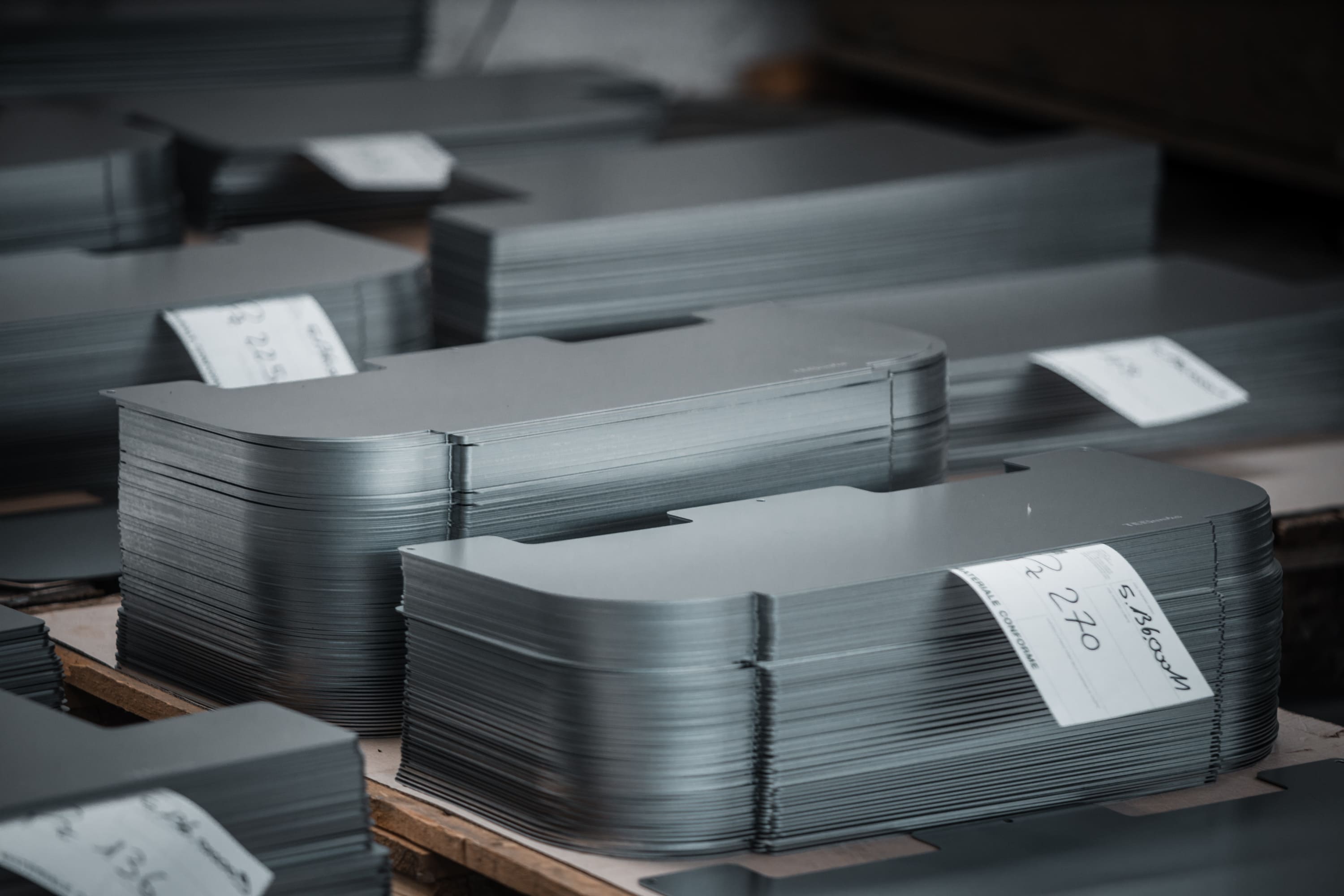
A bookshelf carries weight every day for years, and most of what’s sold in volume hides chipboard or MDF under a thin film of laminate, materials chosen for cost rather than fatigue resistance. Our shelves are folded from a single sheet of cold-rolled, low-carbon steel: the grade engineers call DC01, defined under European standard EN 10130. It belongs to the same family of steel used for car body panels and quality kitchen appliances, valued for its uniform structure, smooth surface and ability to be formed without cracking.
Once formed, the steel is powder-coated in one of eight shades. The powder is applied dry, cured at around 200°C, and bonds chemically to the metal. The result is a finish that does not peel like paint and survives a decade of dust, fingers and the occasional bump from a vacuum cleaner.
Why steel outlives pressed wood

Particleboard is made of wood chips bound by resin. It works fine until it gets damp, until a screw goes back into the same hole twice, or until the cumulative weight of a row of hardbacks pulls its fibres apart. Once it warps, it goes to landfill: there is no real second life for it. Steel does not swell, sag or shed material, and it can be unscrewed and remounted in a new home without any loss of structural properties.
How an invisible bracket carries the weight
The bracket is a flat steel plate that screws into the wall, and the shelf slides over it. Books sit directly on the metal, and the spines hide the fixing entirely. A 60 cm Teebooks shelf carries up to around 15 kg, roughly the weight of 25 hardbacks or 40 paperbacks. Two screws are enough for a single shelf, provided the wall is solid brick or has a proper plasterboard fixing behind it.
The hidden bill of cheap, flat-pack furniture

The price tag of a cheap bookshelf does not tell the whole story. A single piece of fast furniture is estimated to release around 47 kg of CO₂ during its life cycle, and 48.6 million tonnes of furniture were discarded globally last year. Almost none of the particleboard in that pile can be properly recycled, because the resins contaminate the wood fibres and rule out clean reprocessing.
Carbon is one bill, labour is another. A unit priced low enough to sit at the bottom of a flat-pack catalogue has had every cost squeezed out of it, including the wages of the people who built it, and European manufacturers cannot follow that route: paying a living wage, running an audited site, and using a finish that does not off-gas formaldehyde into the living room all show up in the final price.
Replacement frequency is the third hidden cost: survey data on furniture lifespans puts the average flat-pack shelving unit at five to seven years before it is binned, against fifteen to twenty for a steel structure that can be unscrewed, repainted and rehung in a new room without losing any of its strength.
Why a higher upfront price often costs less per year

The maths is straightforward. A steel shelf set kept for fifteen years spreads its price across all of those years, while a flat-pack bookcase rarely lasts more than five before it is binned. Replace the flat-pack three times across the same period (generous, most are gone sooner) and the total spend is often higher than the premium set, before you even count delivery on each one, the time spent reassembling, and the carbon footprint of three units rather than one.
Beyond cost-per-year, modularity and serviceability compound the value. A Teebooks shelf is a single unit you can add to, not a fixed bookcase, so a composition built today grows with the collection without buying a new piece of furniture. Serviceability follows the same logic: a chipped powder coat can be touched up, a relocated shelf can be unscrewed and remounted on a new wall, and our eight colours stay in production so new shelves match existing ones years later.
How a Teebooks shelf is built and why it matters

Teebooks was founded around the idea that a shelf should not draw attention away from what sits on it. The trademark was registered in 2009 by Mauro Canfori, an Italian designer working in architecture and industrial design since 1978. The original brief was minimal: a steel plate, two screws, and a shelf the books appear to float on.
That brief still holds today, and every shelf in our collection ships flat from the same workshop, packed with a fixing kit, in eight colours from white and grey through to rust and black. The same brackets work on plasterboard and brick walls, and our shelves are designed to be combined (single units, vertical sets, modular wall compositions), so a room can be shelved progressively rather than in one panic purchase.
- Cold-rolled, low-carbon steel folded from a single sheet, powder-coated in eight shades.
- Made in Italy under EU labour and environmental standards, ISO 9001 audited.
- Two screws per shelf, invisible bracket, load capacity around 15 kg on a 60 cm shelf.
- Designed to be combined into modular compositions and extended over time.
If you are looking at a wall and trying to picture what comes next, the wall-mounted bookshelves and modular bookcases collections are where most projects start. The full metal shelves range groups every format and colour in one place. For more on the workshop, the designer and how the brand came together, see our story.
Building a room you keep, not one you replace
Ten years from now, the shelf either still sits where you put it on day one or it doesn’t. That single difference is what ‘long-term’ means in practice, and it is what a slightly higher price on day one actually buys: a piece of furniture that ages with the room instead of leaving it for landfill. A wall built one steel shelf at a time, in eight colours that stay in production, is a wall you can keep adding to for a decade.
FAQ
Is ‘Made in Italy’ a regulated label or just marketing?
It is regulated. Italian Law 135 of 2009 requires planning, manufacturing and packaging to happen in Italy, with at least 51 per cent of the production value originating there. Without those conditions, the label cannot legally appear on a piece of furniture sold in the EU.
How does cold-rolled steel compare to particleboard for a bookshelf?
Steel keeps its shape under load and is unaffected by humidity. Particleboard, made of wood chips bound by resin, swells with moisture, loses screw grip after being moved, and cannot be properly recycled because the resin contaminates the fibres. A steel shelf can be unscrewed, repainted and reused for decades.
How long can I expect a Teebooks shelf to last?
A Teebooks shelf is built to last fifteen to twenty years and beyond. The steel does not fatigue, the powder-coated finish resists scratches and dust, and the bracket can be removed and remounted on a new wall without weakening the fixing. Replacement colours stay in production so new pieces can match older ones years later.
Is buying premium furniture genuinely more sustainable?
Yes, when it replaces several short-lived pieces. A flat-pack bookcase typically lasts five to seven years and is rarely recycled because of its resin content. A steel shelf kept for fifteen years cuts the CO₂ tied to manufacturing and transport roughly threefold, and avoids three replacement units going to landfill.